The value of a sales call note is not the note itself.
It is whether the right context becomes usable in the next conversation.
Most sales call notes are written for the moment immediately after the call, when the conversation is still fresh. The rep remembers the tone, the hesitation, the detail behind a short phrase, and the reason a particular next step matters.
Then a few days pass.
The note says:
Good call. Interested. Follow up next week.
Or:
Pain around onboarding. Send deck.
Or:
Wants better visibility.
The rep knew what those phrases meant when they wrote them. Nobody else does. Sometimes even the rep no longer remembers a week later.
Good sales call notes are not about capturing everything. They preserve the parts of the conversation that should carry forward: what changed, what was promised, what remains unresolved, and what the next conversation needs to continue.
A sales note should not be a transcript.
It should be usable memory.
For a broader explanation of how live context becomes useful during a conversation, see What Is a Second Brain for Live Conversations?.
Key Takeaways
- Sales call notes should capture what changed, what matters, and what should happen next.
- A good note gives the next conversation a place to continue instead of forcing the team to start from scratch.
- The most useful notes preserve exact language, commitments, open questions, risks, and next-step context.
- Reps should not have to choose between being present during the call and leaving useful notes afterward.
What Sales Call Notes Are Really For
Sales call notes are not just proof that a call happened.
They should help the team answer a simple question later:
What do we need to remember before we talk to this person again?
That is the standard.
Not whether the note is long. Not whether it captures every topic. Not whether it sounds polished.
A useful note helps with four things:
- Writing a specific follow-up
- Updating the CRM without losing meaning
- Helping a manager or teammate understand the account
- Preparing for the next conversation
If a note does not help with any of those, it is probably just admin.
The best notes are short, but not vague. They give enough context that the next person does not have to replay the whole call to understand what happened.
Why Thin Notes Break Later
Thin notes are tempting because they are fast.
The rep finishes the call, has another meeting in six minutes, and types the quickest version possible:
Interested in live support. Follow up Friday.
That may be enough for the same rep on the same day. It is not enough for the account.
Thin notes usually miss the reason behind the statement.
Interested in what part of live support? Why Friday? Who needs to be involved? What problem made this worth discussing? Was there urgency, or just curiosity?
The danger is not that the note is short. The danger is that it leaves out the meaning.
A better version would be:
Interested in live support because new reps are freezing when prospects ask detailed product questions. Wants to see what guidance looks like during the call, not just after-call notes. Follow up Friday with a short workflow example.
That note is still short. But it gives the next conversation a place to begin.
Why Heavy Notes Also Fail
The opposite problem is trying to write everything down.
Some reps leave calls with pages of notes. Every topic, every feature request, every sentence that sounded important in the moment.
That feels thorough. But it can become hard to use.
A long note creates a different problem: nobody knows what matters.
The next person has to scan the whole thing and guess which parts were meaningful. The follow-up becomes slower. The CRM update becomes messy. The real signal gets buried under detail.
A transcript already captures the full conversation. A sales note should do something else.
It should tell the team:
- What changed?
- What did we learn?
- What needs action?
- What should not be forgotten?
- What should we do next?
Heavy notes often preserve words but lose priority.
Good notes preserve priority.
The Difference Between a Transcript and a Sales Note
A transcript tells you what was said.
A sales note tells you what mattered.
Both can be useful, but they are not the same thing.
A transcript might include five minutes of discussion about onboarding, team structure, manager involvement, CRM usage, and rep ramp time. The sales note should turn that into something usable:
New reps have access to playbooks, but managers still step into calls when detailed questions come up. The issue is not lack of content; it is that reps cannot find the right answer fast enough during live conversations.
That note gives shape to the conversation.
It does not replace the transcript. It helps the team know what to look for if they ever need to revisit the transcript.
The transcript is the record.
The note is the interpretation.
From sales call notes to conversation continuity
A good note does more than summarize one completed call.
It creates continuity between that conversation and the next one.
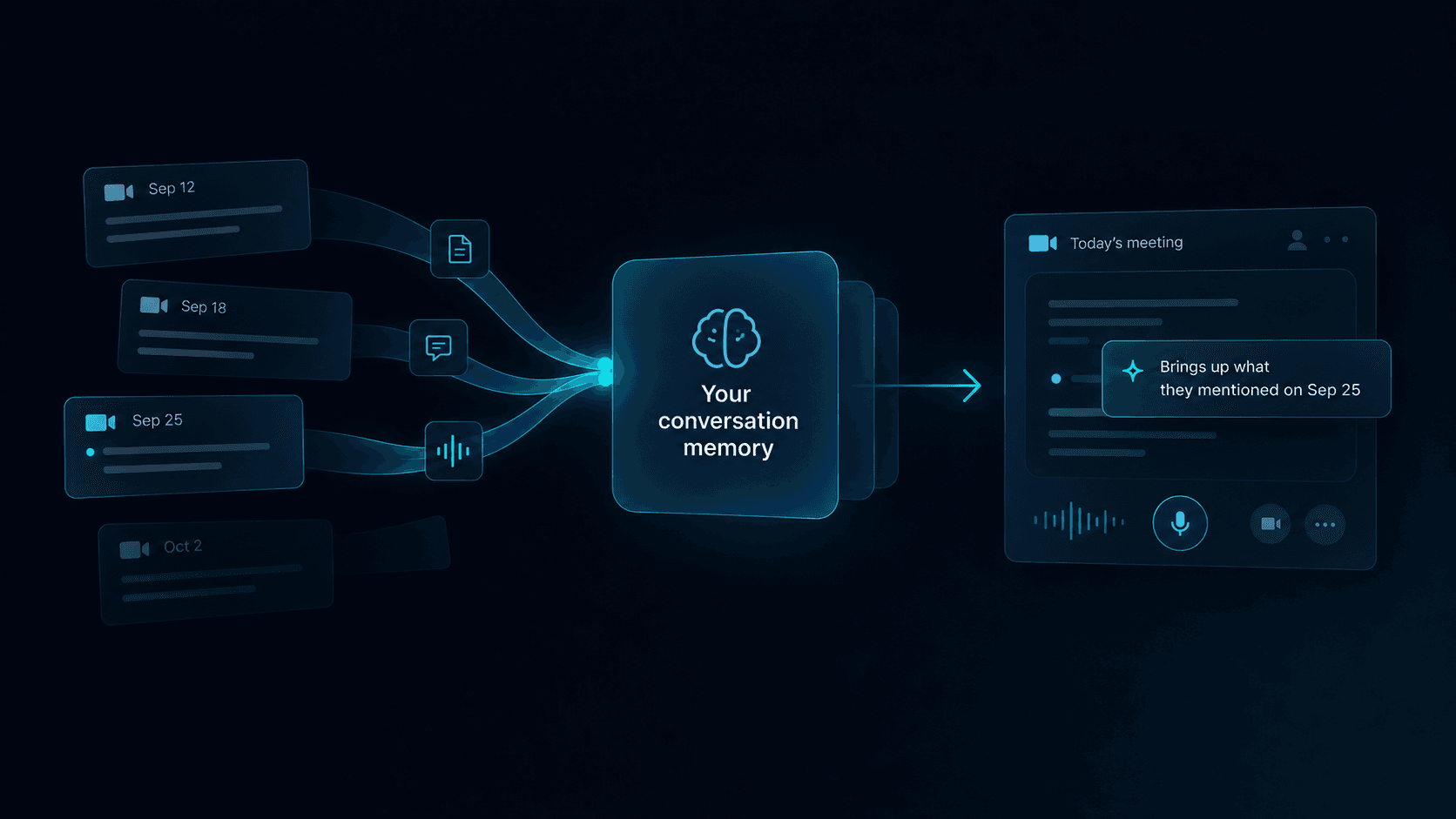
Conversation continuity means the next interaction can begin with the decisions, commitments, unresolved questions, and expectations that already exist. The rep does not have to reconstruct the account from memory, and the prospect does not have to repeat information the team should already know.
The most useful continuity usually comes from a small set of details:
- what changed during the conversation
- what each side committed to do
- what remains unresolved
- what language the prospect used to describe the problem
- what risk or assumption should be revisited
- what the next conversation should accomplish
This is why a transcript alone is not enough.
A transcript preserves the full record. A useful sales note identifies which parts of that record need to travel forward.
The note becomes valuable when that context can reappear:
- while preparing for the next meeting
- during a handoff to another teammate
- when the prospect returns to an earlier concern
- when the conversation changes direction
- when someone needs to understand why the current next step exists
The goal is not simply better documentation.
The goal is to prevent the relationship from losing its memory between conversations.
What a Good Sales Call Note Should Capture
A useful sales call note does not need a complicated format. But it should consistently capture the things that are easiest to lose.
1. What Changed
Every sales call should leave behind a clear sense of what changed.
Maybe you learned a new stakeholder is involved. Maybe the problem is more urgent than expected. Maybe the buyer is less serious than they sounded in email. Maybe the use case is different from the one you assumed.
A weak note says:
Talked about onboarding.
A better note says:
Initial assumption was onboarding content, but the real issue is live-call confidence. New reps have materials, but do not know how to use them when prospects ask unexpected questions.
That is useful because it shows movement.
It tells the next person how the account is different after the call than it was before.
2. The Prospect’s Exact Language
Not every sentence needs to be preserved exactly.
But some lines are worth keeping in the prospect’s own words.
Exact language matters when it reveals:
- Pain
- Urgency
- Internal framing
- Decision criteria
- A strong objection
- A promised next step
- How the buyer explains the problem to themselves
For example, these two notes do not mean the same thing:
Wants better coaching.
And:
We have coaching. The problem is that reps do not know what to do when the customer asks something unexpected.
The first note points toward manager feedback. The second points toward live-call support.
That difference matters.
A good sales note should preserve the second version, because it captures the buyer’s actual framing. It also gives the follow-up a more specific angle.
The rep can write:
You mentioned that coaching exists, but the hard part is helping reps in the moment when a customer asks something unexpected.
That follow-up feels connected to the conversation.
A generic recap does not.
3. Commitments
A lot of trust is lost in small missed commitments.
The rep promises to send something and forgets. The prospect says they will ask someone internally, but the note does not capture who. A technical question comes up, but nobody owns the answer.
Good notes make commitments obvious.
Separate them clearly:
We committed to: Send a short example of what live-call guidance looks like for a new rep.
They committed to: Confirm whether the enablement lead should join the next conversation.
This is not complicated, but it changes the quality of follow-up.
The next email becomes specific. The team knows what was promised. The next call has a reason to exist.
A commitment is not a loose idea.
It is something someone agreed to do.
4. Open Questions
Not everything gets resolved on the call.
That is fine. But unresolved questions should not disappear into the notes.
Examples:
- Who owns the decision?
- Is there budget for this now?
- Is the existing tool a blocker or just part of the workflow?
- What does success need to look like?
- Who else needs to trust the solution?
- What is the real timeline?
Open questions are useful because they tell the rep where the next conversation should go.
A weak note says:
Need to learn more.
A better note says:
Open question: they use an AI note-taking tool today, but it is unclear whether they see live-call support as a separate problem or as part of the same category.
That gives the next call direction.
Without it, the rep may restart the conversation from a vague place.
5. Risks
Risks should be written plainly.
A sales note is not a place to make the deal look cleaner than it is.
If the prospect is not urgent, write that. If there is tool overlap, write that. If the champion seems interested but lacks authority, write that. If the buyer is comparing the product to the wrong category, write that too.
A useful risk note looks like this:
Risk: they may compare this to call recording or AI note-taking. Need to clarify that the value is live context during the conversation, not just a summary afterward.
That note helps the team act.
A vague note like this does not:
Need to clarify value.
Risks are not negative. They are navigation points.
The earlier the team can see them, the better the next conversation can be.
6. Next-Conversation Context
A next step says what will happen.
Next-conversation context says how to make that next step useful.
There is a difference.
Weak next step:
Schedule demo.
Better next step:
Schedule a 20-minute workflow walkthrough focused on the moment when new reps get questions they cannot answer live. Include VP Sales and enablement lead if possible.
The second version tells the team what the next conversation should be about.
That matters because not every demo, follow-up, or stakeholder call should be the same. The next conversation should carry forward the context from the last one.
Good notes prevent the team from starting over.
A Simple Sales Call Notes Template
Use this format after a discovery call, demo, follow-up, or customer conversation.
Call context Who was on the call, what kind of call it was, and why it happened.
What changed What you learned that changes your understanding of the account.
Exact language worth keeping The prospect’s own words when they reveal pain, urgency, decision criteria, or framing.
Commitments What we promised, what they promised, and who owns each item.
Open questions What still needs to be clarified.
Risks What could slow down, confuse, or weaken the deal.
Next-conversation context What the next call or follow-up should focus on.
A completed note might look like this:
Call context: First discovery call with VP Sales. Team is adding new reps this quarter.
What changed: The issue is not lack of training content. New reps have playbooks, but cannot use them fast enough during live calls.
Exact language worth keeping: We have coaching. The problem is that reps do not know what to do when the customer asks something unexpected.
Commitments: We will send a short example of live-call prompts. They will confirm whether enablement should join the next call.
Open questions: Need to understand whether they view this as separate from their current AI note-taking tool.
Risks: Could be grouped with call recording or post-call summary tools unless we clarify the live-call use case.
Next-conversation context: Walk through the exact moment when a rep gets stuck during a live customer conversation.
This note is not long. But it gives the account a memory.
What to Capture During the Call vs. After the Call
Reps should not try to write polished notes while the prospect is talking.
During the call, capture fragments. After the call, turn them into meaning.
During the call, write down:
- Exact phrases
- Names
- Dates
- Numbers
- Commitments
- Strong objections
- Open questions
- Anything you promised to send
Do not try to write full paragraphs live. That usually pulls attention away from the conversation.
After the call, clean up the notes while the context is still fresh.
The rough note might say:
- new reps freeze
- customer asks unexpected q
- has note tool
- send prompt example
- enablement maybe next
The cleaned-up version becomes:
New reps have access to content, but struggle to use it during live customer calls when unexpected questions come up.
Risk: existing AI note-taking tool may create category confusion.
Next step: send short prompt example and schedule workflow walkthrough with enablement if they confirm.
The first version is capture.
The second version is memory.
You need both, but not at the same time.
Once the right context is captured, a sales call recap turns it into clear decisions, ownership, and next steps.
This is also why live conversation support and post-call analysis should not be treated as the same job. One helps while the interaction is still unfolding; the other helps preserve and organize what happened afterward. See Live Conversation Support vs. Post-Call Analysis.
What Not to Put in Sales Call Notes
Good notes also leave things out.
You do not need to capture every greeting, every minor feature question, or every sentence that does not change the account.
Avoid notes that are:
Too generic
Interested in improving sales process.
This could describe almost any call.
Too polished
A note that sounds like a marketing recap often hides the actual messiness of the conversation.
Too complete
A full call summary may be useful in some cases, but if everything is included, nothing is prioritized.
Too internal
Do not write notes only you can understand. If another teammate could not use the note next week, it needs more context.
The test is simple:
Could someone read this note before the next call and understand where the conversation should go?
If not, the note is not finished.
How Sales Call Notes Should Support CRM
CRM notes often become either a dumping ground or a checkbox.
Neither is ideal.
The CRM should hold enough context that the account can move without relying entirely on one person’s memory. But it should not become so cluttered that nobody wants to read it.
A good CRM note should be:
- Specific
- Skimmable
- Honest
- Connected to next steps
- Useful to someone who was not on the call
That last point matters.
The note should not only make sense to the rep who wrote it. It should help a manager, founder, teammate, or future account owner understand what happened.
For example:
Prospect is interested.
Is not enough.
This is better:
Prospect is interested in live-call support for newer reps. Current tools capture calls and notes after the fact, but do not help reps respond when customer questions come up live. Need to clarify whether they see this as a separate category from AI note-taking.
That note is still concise. But it gives the CRM real memory.
How AI Can Help With Sales Call Notes
AI can help reps write better sales call notes, but only if the output is shaped around usefulness.
A long automatic recap is not always helpful. It may be accurate and still bury the important parts.
The best AI support should help pull out:
- The prospect’s exact language
- Commitments
- Open questions
- Risks
- Follow-up items
- Changes in account context
- Details that should matter next time
AI is especially useful when it helps reps avoid the tradeoff between listening and documenting.
The rep should be able to stay present during the call, then quickly turn the conversation into structured memory afterward.
But the goal is not to create more notes.
The goal is to create notes that can be used again.
Where kernous Fits
kernous is a second brain for live conversations. It surfaces the right context the moment the conversation shifts.
Sales call notes are one source of that context.
A conversation creates decisions, commitments, open questions, risks, and language that may matter again later. When those details remain buried in a transcript or a vague CRM entry, the next conversation often starts with incomplete memory.
kernous is designed to help make that context usable again.
Before the next call, the relevant history can support preparation. During the conversation, a compact cue can bring forward the context that has become useful without requiring the rep to stop and search manually. Afterward, the new decisions and unresolved questions can become part of what the team carries forward.
The purpose is not to create more notes.
It is to help the right part of the organization’s memory return when the conversation needs it.
Related reading:
FAQ
What should be included in sales call notes?
Sales call notes should include call context, what changed, exact language worth keeping, commitments, open questions, risks, and next-conversation context. The goal is to capture what the team needs to remember and act on later.
How detailed should sales call notes be?
Sales call notes should be detailed enough to support follow-up and the next conversation, but short enough to skim quickly. A useful note is not a transcript. It is a focused summary of what mattered.
Should reps take notes during the call or after the call?
Reps should capture rough fragments during the call, such as exact phrases, names, dates, commitments, and important questions. After the call, they should quickly turn those fragments into structured notes while the context is still fresh.
What is the difference between a transcript and sales call notes?
A transcript records what was said. Sales call notes explain what mattered. The transcript is the record of the conversation; the note is the usable memory that helps with follow-up, CRM updates, and the next call.
How do sales call notes support conversation continuity?
Sales call notes support conversation continuity by preserving the decisions, commitments, unresolved questions, risks, and next-step context that should carry into the next interaction. A useful note helps the team continue the conversation instead of asking the prospect to repeat information or forcing the rep to reconstruct the account from memory.
Can AI help write sales call notes?
Yes. AI can help extract exact language, commitments, risks, open questions, and follow-up items. The most useful AI-generated notes are not just longer summaries. They help preserve context that can be used in future conversations.