An AI can summarize a meeting without knowing how that meeting connects to everything that came before it.
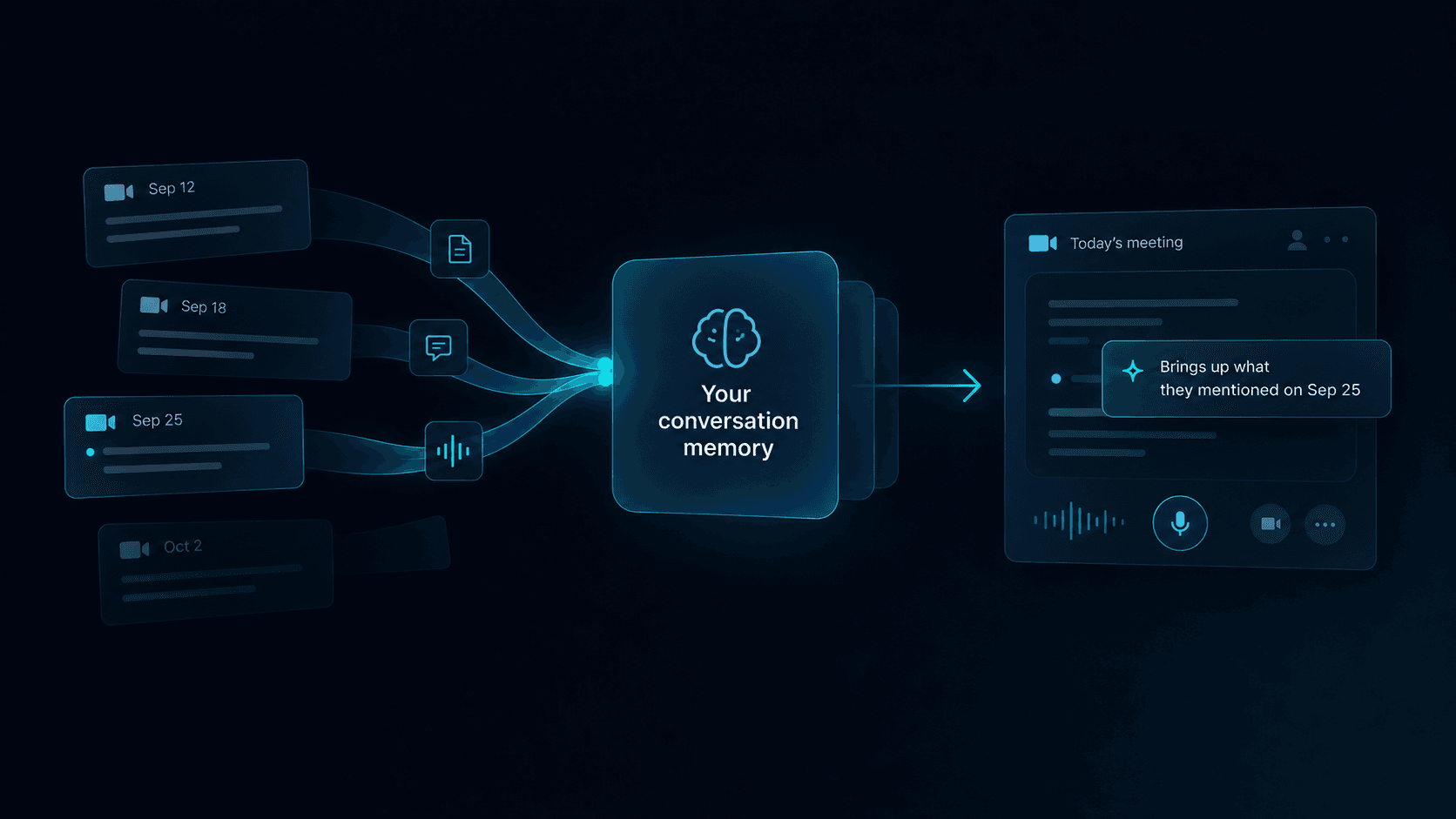
Cross-meeting memory, sometimes described as persistent context, means connecting relevant information across previous conversations so it can become useful again later.
As that history grows, the job gets harder. An earlier decision may be replaced. A tentative note may start sounding like a confirmed fact. Two conversations with the same company may not even belong to the same project.
So the useful question is what that memory is actually doing.
Conversation continuity is about what should carry forward from one conversation to the next. Here, we are looking at what an AI has to get right for that memory to stay useful.
1. It should know which conversations belong together
Before an AI can remember across meetings, it has to know which meetings are part of the same thread.
A customer relationship might include discovery calls, product reviews, implementation conversations, and follow-ups with different people. Meeting titles may change completely.
At the same time, the same company might have two separate projects running in parallel.
Treat everything as one history and unrelated context starts bleeding together. Keep every meeting isolated and the memory never extends beyond a single call.
The first challenge is connecting the right conversations without collapsing everything into one account-wide archive.
2. It should know what matters
Once conversations are connected, there is still too much information to treat every detail equally.
A transcript may contain thousands of words. Three weeks later, the useful part might be one decision, one unresolved concern, or one commitment near the end of the call.
If everything receives the same weight, the parts that matter become harder to find.
Selection cannot be final, either. Something minor today may matter in the next conversation, so the fuller record still needs to be available when it does.
3. It should know when something changed
In August, a customer says:
We want to launch in October.
A month later:
Security review has pushed the timeline back.
Both statements belong in the history. Only one reflects the current situation.
This creates a basic problem for AI retrieval: both pieces of information match the topic of “launch timing.” Topic similarity alone does not tell you which one is current.
Cross-meeting memory needs some sense of sequence — what came first, what changed later, and whether newer information has replaced an earlier assumption.
Otherwise, an AI can retrieve something that was true when it was said and still give you the wrong context today.
4. It should keep the source attached
Memory can drift as information gets summarized and carried forward.
Take this sentence:
The customer requires SSO.
Maybe the customer said directly:
SSO is a requirement for us.
Maybe someone on the team wrote:
They mentioned SSO would be nice to have.
Or maybe a product document simply says that SSO is available.
Those statements should not gradually collapse into the same fact.
Each round of summarizing creates another opportunity for wording to become firmer than it originally was. A preference can turn into a requirement. An assumption can start sounding like something the customer explicitly confirmed.
When old context comes back, it should still be possible to trace it to the moment it came from and check the original wording.
5. It should be clear whose memory it is
Suppose a teammate spoke to the same customer last week.
That conversation may contain context that would help you. It may also include information that was never meant to become part of your working history.
Being connected to the same account does not automatically make every conversation one shared memory.
The person using an AI assistant should have a reasonable understanding of what information is being carried forward and where it came from.
That matters for access and privacy.
The real test comes during the next conversation
Many memory features are useful when you stop and ask them a question.
A live conversation is different. The question often comes from the other person.
A customer asks:
Why did we decide to phase the rollout again?
The answer may sit somewhere in a meeting from two months ago.
The useful piece might be much smaller:
The team chose a phased rollout because the customer wanted to reduce implementation risk.
That is enough to restore the thread.
You can explain the earlier decision, ask whether the reasoning still holds, or explore what has changed since then.
The memory supports the conversation. It does not decide what happens next.
Where kernous fits
The questions above are ones we would ask of any AI that claims to remember across meetings, kernous included.
kernous can carry relevant context from previous conversations into the next one. During a live conversation, it can bring relevant notes and knowledge into view as the discussion unfolds.
You can also add knowledge you want available as context.
The goal is to make the thread easier to pick up when it becomes relevant again, while leaving the person in the conversation to decide what to use and what to explore next.
That is what we mean by a second brain for live conversations.
FAQ
What is cross-meeting memory?
Cross-meeting memory is the ability to connect relevant context across previous conversations and make that information useful again later. It is sometimes described as persistent context.
How is cross-meeting memory different from meeting notes?
Meeting notes capture information from a conversation. Cross-meeting memory also has to connect related conversations, account for changes over time, and bring earlier context back when it becomes relevant again.
Why does the source matter in AI memory?
Each round of summarizing can make a statement sound firmer than it originally was. Keeping the source attached makes it possible to check what was actually said and how the information entered the record.
Does kernous remember previous conversations?
kernous can carry relevant context from previous conversations into the next one. During a live conversation, it can bring relevant notes and knowledge into view as the discussion unfolds. You can also add knowledge you want available. The person in the conversation decides what to use.