A customer says:
“Last quarter, your team said this would be resolved before renewal. Is that still happening?”
The answer may already exist—in a previous call, a support ticket, a product update, or someone’s notes.
But during a live conversation, knowing that the answer exists is not enough. Someone still has to remember where it was recorded, search for it, verify that it is current, and turn it into a useful response without losing the thread of the conversation.
A second brain for live conversations is designed for that moment.
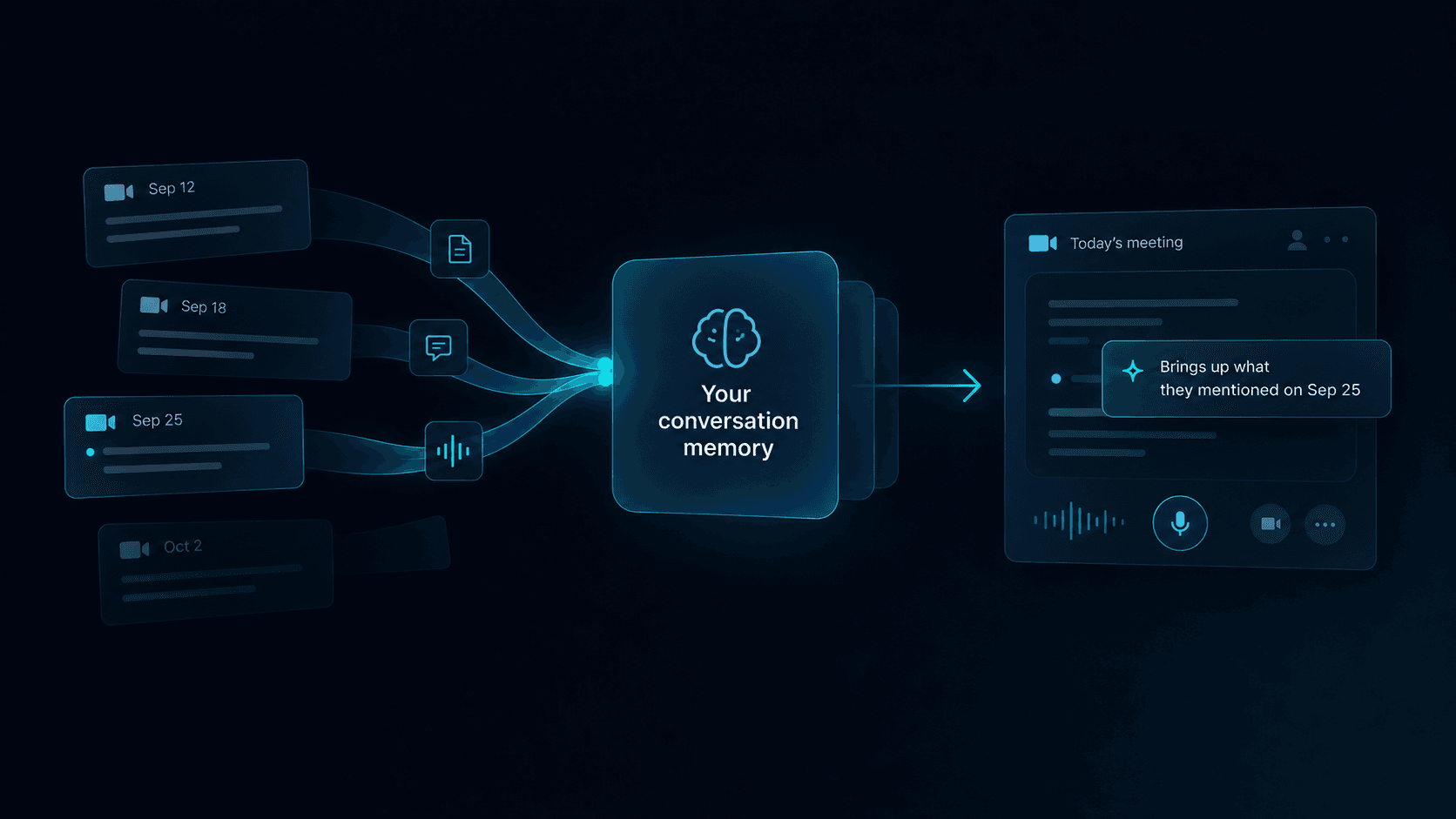
It connects the conversation happening now with the knowledge, history, and decisions that have become relevant—and surfaces that context while it can still affect what happens next.
What is a second brain for live conversations?
A second brain for live conversations is a system that helps people use organizational context while a conversation is happening.
It does more than preserve what was said. It identifies what may matter now.
That context might include:
- a commitment made in an earlier conversation
- an unresolved customer concern
- a relevant product or policy detail
- the reasoning behind a previous decision
- an approved answer from internal documentation
- a question that would clarify what the other person means
The goal is not to show everything the organization knows.
The goal is to surface the smallest amount of useful context at the moment it becomes relevant.
The gap is timing
Most teams already have more information than any one person can remember.
They have transcripts, CRM records, meeting notes, internal documentation, account histories, support tickets, project decisions, and message threads.
The problem is that these systems usually require the person to leave the conversation mentally—or literally—to search.
That creates a timing gap.
An answer can be correct and still arrive too late.
A summary sent after the call may improve documentation. It cannot recover the moment when a customer was waiting for an answer, an investor was challenging an assumption, or a client was deciding whether the team understood their history.
This becomes especially important when the conversation changes direction.
A meeting may begin with one agenda and quickly move somewhere else:
“Before we continue, can we go back to what was promised last quarter?”
“What assumption is that forecast based on?”
“Has anyone already tried fixing this?”
Each shift creates a new information need. The useful context is no longer just the material prepared before the conversation. It may now depend on an older decision, another team’s work, or a previous interaction.
A second brain should respond to that shift before the moment passes.
A concrete example
Imagine a customer-success conversation about an upcoming renewal.
The customer says:
“We were told the export limitation would be removed before renewal. Is that still happening?”
Without accessible context, the account manager may need to:
- pause the conversation
- search old notes and internal messages
- ask the customer who made the commitment
- promise to follow up later
The customer has to help reconstruct the company’s own history.
An illustrative live-context cue might show:
Previous commitment — April 18 call: Team agreed to confirm whether the export limitation could be removed before renewal.
Current status — Pending product review. Owner: Maya.
Source — April 18 meeting note · Product review thread
The person can now respond with the relevant history and current status without pretending the issue is resolved:
“You’re right—that was left as an open commitment. It is still pending product review, and Maya is the current owner. Let’s confirm the decision and timing before we move on.”
The system has not written the entire response or made the decision.
It has restored the context needed for the person to respond accurately.
Why notes, transcripts, and knowledge bases are not enough
These tools remain useful, but they answer different questions.
A transcript answers:
What was said?
Notes answer:
What did someone decide was important?
A knowledge base answers:
What does the organization know about this topic?
A second brain for live conversations answers:
What matters in this moment?
That distinction matters because static preparation cannot predict every direction a conversation may take.
The person still needs help connecting the current exchange with the relevant part of the organization’s memory.
What useful live context looks like
Useful context during a conversation needs to be more than accurate.
Relevant
It should connect directly to the current question, concern, or decision.
A list of ten loosely related documents creates more work.
Timely
It should appear while the person can still use it.
Context that arrives after the conversation has moved on may no longer change the outcome.
Brief
The first layer should be understandable at a glance.
A short summary, status, source, or unresolved question is usually more useful than a full document during the conversation.
Traceable
The person should be able to see where the information came from.
Live support should connect back to the relevant note, document, ticket, or earlier conversation rather than presenting unsupported text.
Optional
The person should be able to ignore, dismiss, or expand the information.
The system should support attention, not compete for it.
Judgment-preserving
It should help the person understand the situation without forcing a response.
The final interpretation and decision should remain with the person in the conversation.
Action value versus interruption cost
Not every relevant piece of information deserves to appear during a live exchange. A useful cue is one whose likely improvement to the next response outweighs the attention it takes to read; anything below that bar should stay quiet. The full trade-off is explored in Live Conversation Support vs. Post-Call Analysis.
A useful second brain should not optimize for the number of prompts it can display.
It should optimize for knowing what deserves to interrupt.
Before, during, and after the conversation
Conversation support spans three connected stages.
Before
Preparation provides the likely agenda, relevant history, open questions, and useful materials.
It reduces uncertainty but cannot predict every turn.
During
The system responds to what is happening now.
When the conversation shifts, it surfaces the knowledge or history that has become relevant without requiring the person to reconstruct it manually.
After
New decisions, commitments, and unresolved questions are preserved for the next interaction.
This creates continuity instead of leaving the next conversation to begin from a raw transcript or incomplete memory. For a deeper look at carrying decisions, concerns, and commitments across meetings, see conversation continuity.
Each stage matters, but they are not interchangeable.
Preparation cannot replace live support. Post-conversation analysis cannot recover a missed moment.
The same need appears across different conversations
The content changes across roles, but the underlying pattern remains similar.
- Sales: A customer introduces a concern connected to an earlier requirement or decision.
- Customer success: A customer returns to an unresolved issue or previous commitment.
- Investor conversations: A current metric depends on historical assumptions or an earlier strategic choice.
- Service and support: A problem is connected to previous troubleshooting, escalation, or a temporary workaround.
- Internal and advisory conversations: A discussion shifts from execution to the reasoning behind an earlier decision.
These are not identical workflows. They are examples of the same information problem:
The relevant context exists, but it needs to become usable while the conversation is still happening.
What a second brain for live conversations is not
It is not only a meeting recorder
Recording and transcription preserve a conversation. They do not necessarily help someone use earlier knowledge during it.
It is not only post-call analysis
Post-call tools can summarize, score, and analyze a completed conversation.
A second brain focuses on the responses and decisions that still need to happen before the conversation ends.
It is not a voice agent
A voice agent participates in or completes a conversation on someone’s behalf.
A second brain supports the person who is already in the conversation.
It is not a rigid script
Scripts assume that a conversation will follow a predictable path.
A second brain becomes most useful when the conversation moves outside that path.
It is not a constant stream of prompts
More suggestions do not automatically create better support.
Unnecessary prompts increase cognitive load and pull attention away from the person on the other side of the conversation.
Where kernous fits
kernous is a second brain for live conversations. It surfaces the right context the moment the conversation shifts.
In practice, that means the experience should remain quiet until something becomes useful.
When a conversation refers to an earlier commitment, unresolved issue, product detail, or previous decision, kernous can surface a compact cue with a short, relevant summary and the supporting context needed to decide what to do next.
The first layer should be short enough to understand without leaving the conversation. More detail can remain available when it is useful.
kernous is not intended to replace judgment or turn every interaction into a scripted exchange.
It is designed to make organizational memory usable while the conversation is still moving—so the person can respond with better context, ask a more informed question, or recognize when the issue needs a different next step.
Related reading:
- Real-Time Help During Sales Calls
- Real-Time Sales Coaching: Live Guidance for Calls
- Sales Call Notes: How to Capture What Matters for the Next Conversation
How to evaluate a second brain for live conversations
A useful system should be evaluated by what it changes during the conversation, not only by the quality of its output afterward.
Questions to ask include:
- Does the context appear quickly enough to be useful?
- Is it specific to the current conversation?
- Can the person understand where it came from?
- Is the first layer concise enough to read at a glance?
- Can the person dismiss or expand it?
- Does the system distinguish useful context from unnecessary interruption?
- Does it carry decisions and unresolved questions into the next interaction?
- Does it preserve human judgment?
A strong system should make the person feel more present, not more distracted.
FAQ
What is a second brain for live conversations?
A second brain for live conversations is a system that surfaces relevant knowledge, history, and decisions while a conversation is happening. It helps a person use existing context without leaving the conversation to search manually.
How is it different from an AI meeting assistant?
Many meeting assistants focus on recording, transcription, summaries, and action items. A second brain focuses on context that can still affect the conversation before it ends.
Does it replace human judgment?
No. It provides context and support while leaving interpretation, judgment, and the final response to the person in the conversation.
What kinds of conversations can it support?
The same pattern can appear in sales, customer success, investor, service, support, advisory, and internal conversations. The information differs, but the need for timely context remains similar.
Why are notes and transcripts not enough?
Notes and transcripts preserve information, but the person still has to find and interpret the relevant part. A second brain helps identify what matters in the current moment.
Should live context appear constantly?
No. Live support should be selective. Information should appear when its value is greater than the interruption it creates.