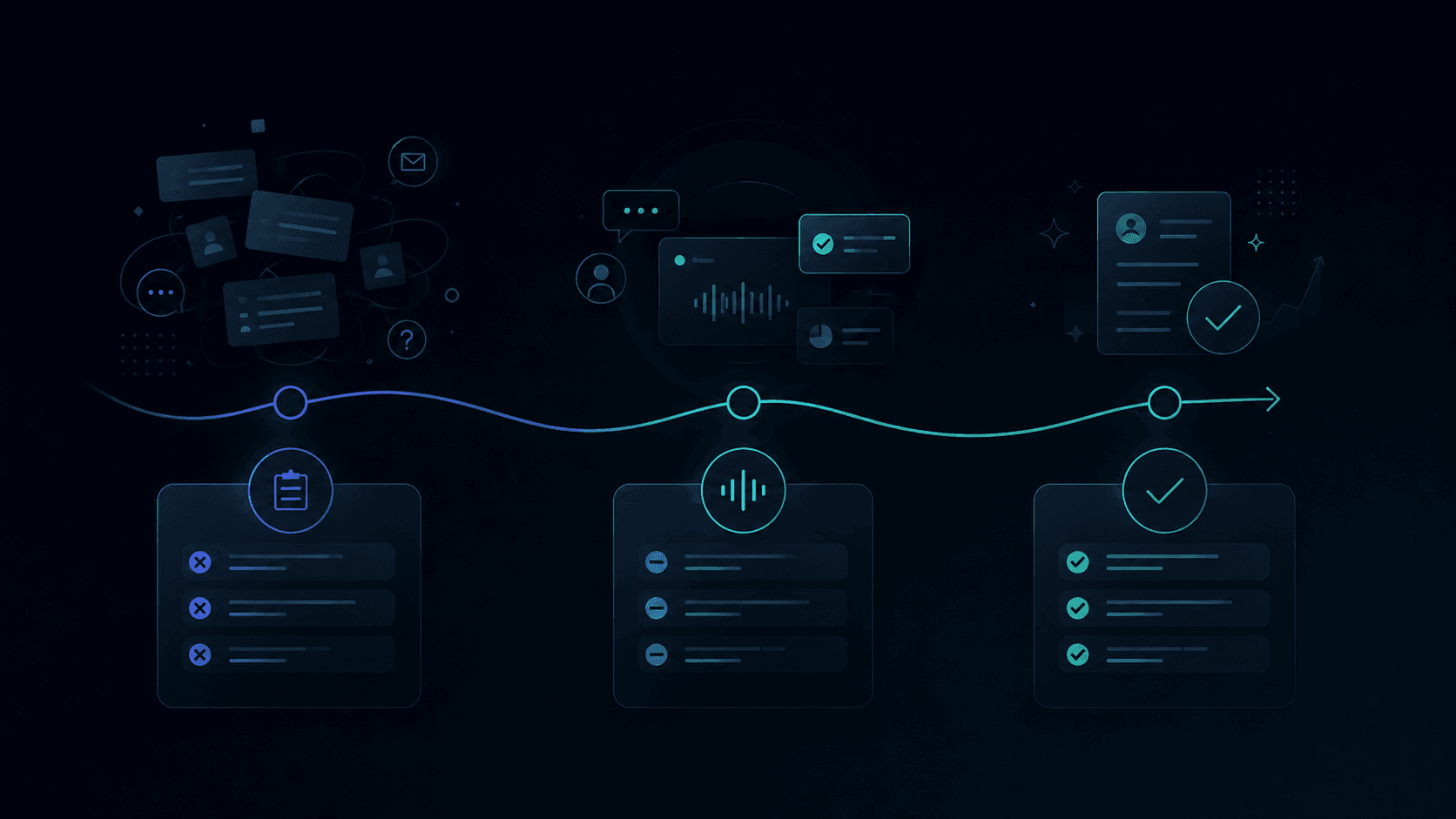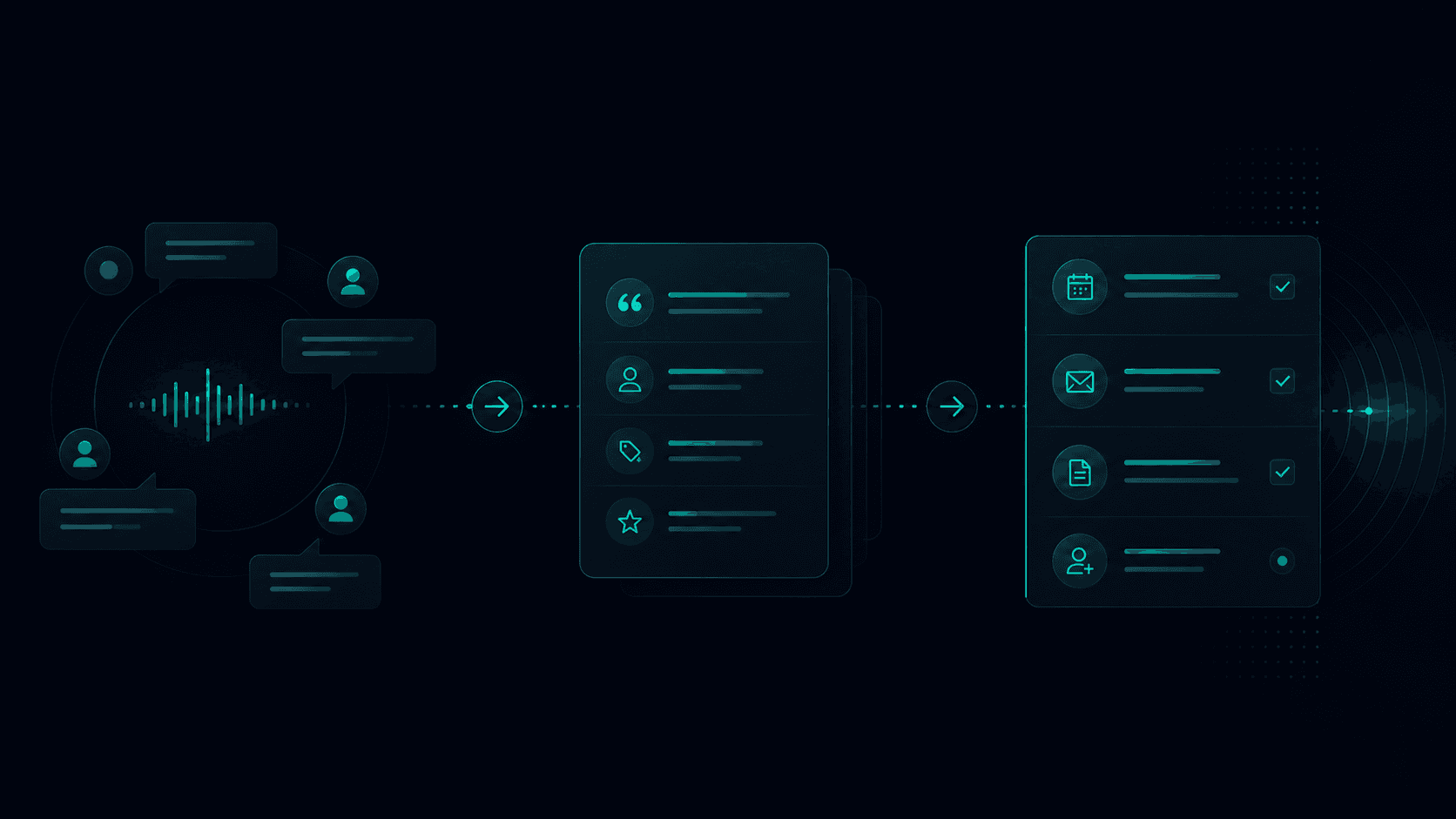
To prepare for a sales call, confirm the purpose of the meeting, review the relevant account and stakeholder context, and decide what you need to learn or resolve. For a first call, start with research. For a follow-up, start with the history your team already has.
For an ongoing relationship, useful information may be spread across previous calls, CRM updates, meeting notes, email, internal messages, and follow-ups. The challenge is figuring out what from that history matters for the conversation you are about to have.
Preparation becomes an information assembly task: bringing the relevant history together for the next call.
Good sales call preparation should help you get up to speed quickly and enter the conversation knowing what has changed, what remains open, and what the customer already expects your team to remember.
What Should You Review Before a Sales Call?
The details worth reviewing depend on whether this is a first conversation or part of an ongoing relationship. For an existing customer or active opportunity, six questions usually surface most of what matters.
| Review | Ask yourself |
|---|---|
| Recent changes | What changed since the meeting was booked or since we last spoke? |
| Previous decisions | What has already been agreed, rejected, or postponed? |
| Commitments | What did our team or the customer promise to do, who owns it, and what is its status? |
| Open questions | What still needs a clear answer? |
| People | Who is joining, and what context do they already have? |
| Likely needs | What information may matter if a known topic comes up? |
Focus on the parts of the account history that could influence what happens next.
A customer may have sent a new requirement after the last meeting. A timeline may have shifted. Someone on your team may have promised to confirm a product capability. A stakeholder joining today may not share the context everyone else already has.
Those details belong in pre-call preparation because they change how the conversation should begin.
First Call vs. Follow-Up Call: Your Sources Should Change
For a first sales call, most of your context has to come from outside the relationship.
Confirm why the meeting was booked, research the company and the stakeholder’s role, and review relevant public information. Write down a working hypothesis about their needs, two or three questions to test it, and a useful next step if there is a fit. Treat that hypothesis as something to check with the customer.
For a follow-up or ongoing customer call, the most useful source is usually the relationship itself.
The previous conversation already created information that generic account research cannot give you: what the customer cared about, what they questioned, what they agreed to, what your team promised, and what was left unfinished.
That means a follow-up call should begin with the team’s available conversation context.
External research may still matter, especially if something significant has changed. But it should complement the customer history your team already has, not replace it.
Look for Open Loops, Not Another Account Summary
Account summaries are useful. They help you remember who the customer is, what happened previously, and where the opportunity stands.
When reviewing a summary, look specifically for open loops: items that still need attention. If the summary leaves them out, check the underlying notes and follow-ups.
An open loop could be a question that never received a complete answer, a commitment that still needs follow-up, an objection that was acknowledged but not fully resolved, a decision waiting on another stakeholder, or a customer priority that may have changed.
Keep each open loop tied to its owner, latest status, and source so you can check what has happened since it was recorded.
Imagine the last call ended with a customer asking whether a specific integration was possible. Someone on your team said they would check. The meeting recap may accurately summarize the entire conversation, but the most important thing before today’s call is much simpler: did that question ever get answered?
That is the kind of context that changes the next conversation.
Better Notes Help—If They Make the Next Conversation Easier
Teams often respond to preparation problems by improving documentation.
That is useful. Clear sales call notes should capture decisions, concerns, follow-ups, and important customer context.
The next challenge is making those records usable later.
An account can contain months of meetings, emails, CRM updates, documents, and internal discussion. The rep preparing for today’s call still has to identify what from that history deserves attention now.
This is why the quality of call notes matters beyond record-keeping. The best notes make it easier to find decisions, commitments, unresolved questions, and next steps when they become relevant again.
The value of documentation shows up when someone can use it without rereading the entire account history.
Preparation Gets Harder When the Conversation Changes Hands
The context problem becomes much clearer when more than one person is involved.
Suppose an SDR runs the initial discovery call and hands the account to an AE.
The CRM contains the formal account information. The meeting notes capture part of the conversation. A product concern was discussed internally in Slack. The customer later sent an update by email.
Before the AE can plan the next conversation, they first have to reconstruct what the team already knows.
The critical question becomes:
What context survived the handoff?
A good handoff involves more than transferring a contact record or a meeting summary. The next person needs to understand what matters now: what the customer is trying to accomplish, what has already been discussed, where uncertainty remains, and what the team is expected to do next.
The same issue appears when an account owner is unavailable, a specialist joins midway through a process, or a new customer stakeholder enters an existing conversation.
Customer history becomes team context only when the people joining the next call can actually use it.
What Happens When Pre-Call Context Is Incomplete?
Weak preparation often becomes visible only after the call starts.
A customer repeats something they already explained. A rep asks a question that was settled earlier. A promised follow-up gets missed. An old concern reappears because the person on today’s call did not know it had already been discussed.
Sometimes the rep realizes the gap while the customer is speaking and starts searching the CRM, Slack, notes, or documents for information the team already has.
Reviewing known commitments before the meeting reduces avoidable searching. During the call, real-time help can make relevant context easier to access as a question develops, including details from earlier conversations that become relevant again. Preparation gives you a starting point; live support helps you use context as the conversation changes.
The stronger the pre-call context, the more attention a rep can give to the conversation itself.
Turn the Context Into a Short Call Plan
Before joining, turn your review into a few lines you can use while listening:
- Purpose: What do we need to learn, confirm, or resolve today?
- Priority questions: Which two or three questions follow from the research or open loops?
- Commitment updates: What can we confirm now, and what still needs an owner or an answer?
- Possible next step: What would make sense if the customer agrees, and who needs to be involved?
For the integration example, that might mean checking the technical owner’s response before the call, confirming the customer’s required workflow, and proposing a technical discussion if feasibility is still unresolved. Keep the supporting source nearby and mark any uncertainty clearly.
A Better Starting Point for Pre-Call Planning
A rep should enter the call with a concise view of what matters now: recent changes, unresolved questions, commitments, relevant stakeholders, and the information most likely to shape the next step.
From there, judgment stays with the person running the conversation.
They decide what to ask, which issue deserves attention, and how to respond to what the customer says.
The preparation system has a simpler job: make the conversation context the team already has easier to use at the moment it matters.
That becomes especially important as customer history grows and conversations move between different people.
For a broader look at how information breaks down before, during, and after customer conversations, read where information breaks down before, during, and after a conversation.
If your team is already working on maintaining continuity across customer conversations, you can also read conversation continuity.
In kernous, you can add notes, documents, and links to a customer’s record for use in your conversations. Bring in any CRM, email, or messaging content you need; these systems do not sync automatically with kernous. You decide which open questions and commitments belong in the next call’s plan.
Interested in using kernous with your team? Request early access.
For product questions, explore the kernous FAQ.
FAQ
What should you review before a sales call?
Review the reason for the meeting, recent account changes, relevant customer history, previous decisions, open questions, commitments, stakeholders, and any information likely to matter during the conversation. For a first call, external account and stakeholder research will matter more; for a follow-up call, previous conversation context becomes more important.
How should you prepare differently for a follow-up sales call?
Start with what happened in the existing customer relationship. Review previous decisions, unresolved questions, commitments, stakeholder changes, and anything that has changed since the last conversation. External research can supplement that history, but it should not replace the context your team already has.
What is the difference between a call summary and an open loop?
A call summary records what happened during a conversation. An open loop is something that still requires attention, such as an unanswered question, an unfinished commitment, an unresolved objection, or a pending decision. Open loops are especially useful during pre-call planning because they indicate what may matter next.
How do you prepare for a follow-up call when you missed the previous meeting?
Start with the team’s available conversation context: previous notes, decisions, commitments, unresolved questions, stakeholder history, and recent account changes. Focus first on understanding what matters for the upcoming conversation, then fill any remaining gaps with CRM, email, documents, or account research.