A sales call ends, but the relationship doesn't reset when the line goes dead.
The customer is waiting on an answer. They flagged a concern that still needs a response. They agreed to a next step with someone on the account team. A decision-maker who wasn't on the call is about to ask what happened.
A week later, another conversation begins. Maybe it's the same rep. Maybe it's a solutions engineer joining for the first time, or someone from customer success picking up after the deal closes.
Someone opens the call by asking for a recap. The rep scrolls through CRM notes, a call recording, and a Slack thread trying to reconstruct where things stood. The customer repeats a concern they already explained last time. The latest account context isn't in front of anyone. The first ten minutes go to rebuilding what the customer assumed everyone already knew.
The earlier conversation was recorded somewhere. Its context did not carry forward into this one.
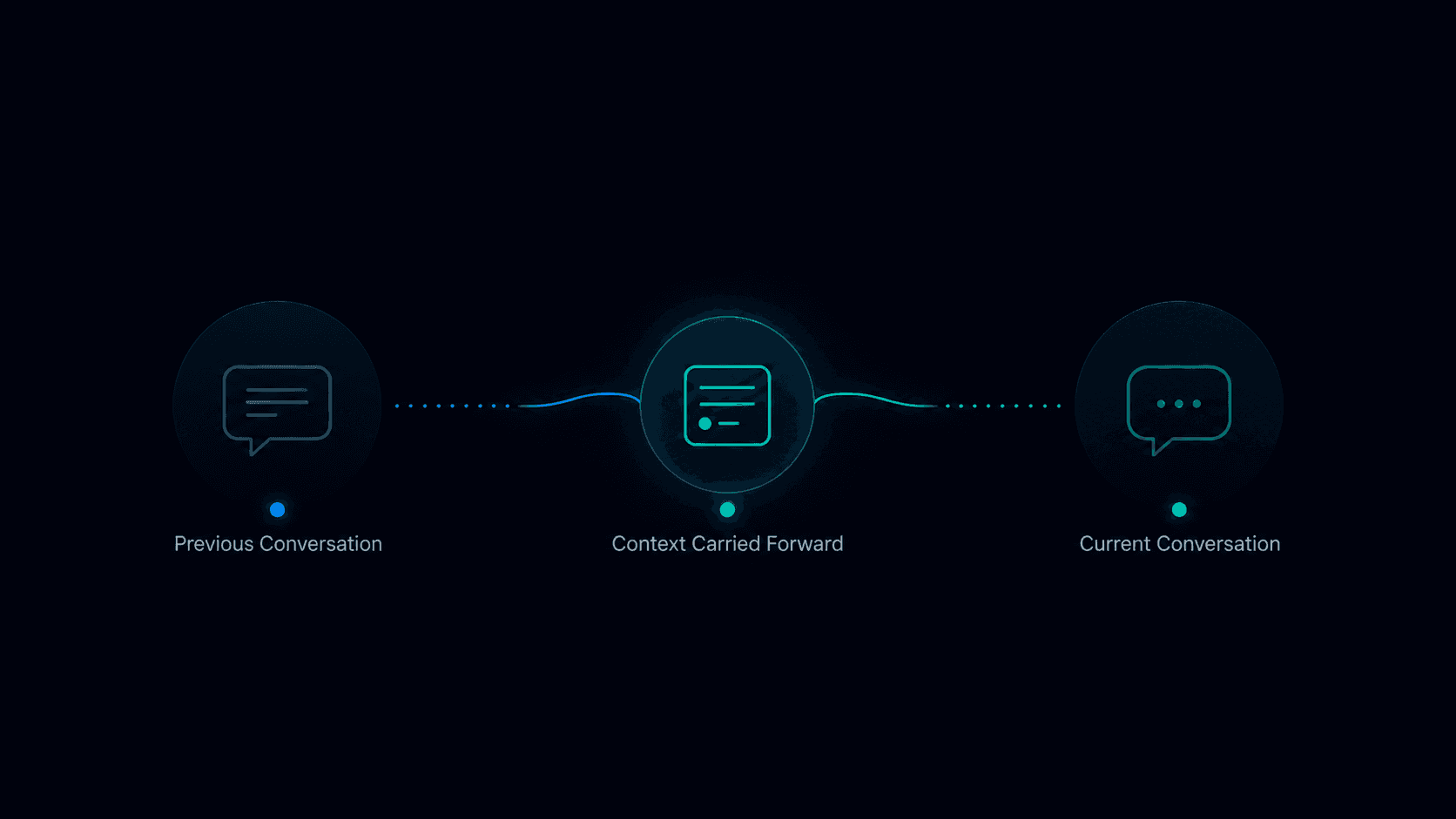
In sales and customer-facing work, conversation continuity means carrying relevant context from one customer conversation into the next, so the relationship can move forward without restarting from zero.
It allows a deal, an account, or a customer relationship to keep moving without forcing the customer to rebuild the story every time someone new joins the conversation.
Key Takeaways
- Conversation continuity means carrying the relevant state of a customer relationship into the next conversation, not just remembering what was said.
- A transcript or call summary can preserve what was said without showing what matters now.
- Useful continuity includes decisions, concerns, commitments, open questions, ownership, and changes since the last conversation.
- The next call should begin with enough context to move forward, without requiring the customer to repeat themselves or the rep to review the entire history.
- AI can help organize and retrieve customer context, but people still need visibility into the source, timing, and certainty of the information.
What Is Conversation Continuity in Sales?
Conversation continuity is the preservation of meaningful customer context across separate conversations.
Those conversations may happen minutes apart or months apart. They may involve the same rep, a new specialist joining the deal, or a handoff from sales to customer success. They may move from a discovery call to a technical demo, or from a sales conversation to an implementation kickoff.
Even when the channel or the person on the call changes, the customer relationship should still feel connected.
Continuity gives the next participant enough understanding to answer three questions:
- What has already happened with this customer?
- What matters to them right now?
- What should this conversation move toward?
A complete transcript can answer the first question eventually. It is much less reliable at answering the other two quickly, and a customer waiting on a live call won't wait for someone to read it.
That distinction matters because customer relationships do not form a neat sequence of isolated meetings. They form an evolving relationship between people, priorities, decisions, and expectations.
Why Context Disappears Between Customer Conversations
Context is rarely lost all at once. It fades through small breaks in the workflow.
A decision lives in a call transcript. The reason behind it remains in the rep's memory. A commitment appears in a follow-up email. The customer's concern is recorded in the CRM, but the internal discussion about how to resolve it happens in Slack. An account update is written down without mentioning that the renewal date has become time-sensitive.
Each system preserves a piece of the story. The next person on the account has to assemble those pieces under time pressure, often while the customer is already on the line.
The Record Is Fragmented
Customer conversations produce information across calendars, calls, emails, chat threads, CRM fields, and support tickets.
Each location may be useful on its own. The difficulty appears when someone needs to understand the full situation before the next call starts.
A customer's request may be documented in call notes, while the internal decision about that request sits in a private Slack message. A concern may appear in a call transcript, while the product team's response is stored in an issue tracker. A support ticket may record what broke without showing what the customer was told on the sales call that led to the purchase.
The history exists, but its meaning is distributed.
Summaries Flatten the Conversation
A summary can reduce an hour-long meeting to a few paragraphs. That is useful for recall, but compression removes detail.
Consider the difference between:
The customer asked about implementation timing.
and:
The customer is comfortable with the product direction but cannot move forward until implementation confirms that the migration can be completed before the October renewal.
Both statements are accurate. Only the second one explains what the next conversation needs to resolve.
A useful context record has to preserve more than the topic. It needs to retain the reason the topic matters.
Ownership Changes
The person entering the next conversation may not have attended the previous one.
An account executive hands an account over to onboarding. A solutions engineer joins a deal for the first time to answer a technical question. A support rep picks up a renewal conversation that sales started months earlier. A rep goes on leave and a teammate covers their pipeline.
The new participant may receive the notes and still miss the interpersonal context: which issue is sensitive, which promise has already been made, which option the customer already rejected, and what the customer expects to happen next.
When ownership changes, the next person needs more than a task list. They need enough context to understand the expectations already in place with that customer.
Time Changes the Meaning of Information
Context has a time dimension.
An objection that was critical last month may already be resolved. A tentative budget may now be approved. A feature mentioned as planned may now be available, delayed, or removed. The stakeholder who owned the decision may no longer be involved.
Older information remains part of the history, but it should not automatically be treated as the customer's current state.
Useful continuity shows how the situation has changed since the last conversation.
What Should Carry Into the Next Customer Conversation?
The next call does not need every sentence from the previous one.
It needs the parts that change how the conversation should continue.
| Context element | Why it matters later | Example |
|---|---|---|
| Current objective | Keeps the next call focused on the same outcome | The customer is evaluating whether the product can support a November rollout |
| Prior decisions | Prevents the team from reopening settled questions | The account already agreed to a phased rollout |
| Concerns and constraints | Preserves what may block the deal | Security review must finish before procurement begins |
| Commitments | Protects trust and accountability | The team promised to provide an implementation estimate by Friday |
| Open questions | Gives the next call a clear starting point | The data migration scope is still unconfirmed |
| Ownership | Clarifies who is responsible for the next step | The solutions engineer will confirm the technical limitation |
| Relationship context | Helps the rep respond with the right tone and depth | The customer is enthusiastic but still needs to bring procurement on board |
| Changes since the last interaction | Keeps older information from becoming misleading | The target launch date has moved forward by two weeks |
Together, these details describe the current state of the customer relationship.
That view is generally more useful at the beginning of the next call than a chronological recap of everything that was said.
Continuity Looks Different Across Customer-Facing Conversations
The underlying need is consistent, although the context that matters changes by situation.
Sales Conversations
A prospect should not have to re-explain their priorities every time a new specialist joins the call.
The next person on the account should already understand why the customer is evaluating the product, what their priorities and workflows are, which concerns or objections have already come up, what has been demonstrated, which decisions have already been made, who the other stakeholders are, and which commitments remain open. Recent account activity, like a support ticket or a pricing question sent by email, should carry forward too, since it can change what the next call needs to cover.
None of this means reproducing a full transcript of every prior call. It means surfacing the handful of details that change how the next conversation should go, so the rep can prepare with demo call preparation that reflects where the account actually stands rather than starting from a blank page.
During the call, that context can also help the team decide whether a question needs clarification, verification, or follow-up. The process is explored in more detail in how to handle questions you can't answer during a sales call.
Customer Success and Implementation
After a sale, continuity protects the expectations established before the handoff.
The implementation team needs to know which outcomes influenced the purchase, which requirements were treated as essential, and whether the customer heard any timelines or promises that now shape the relationship. A well-run customer kickoff call depends on that context arriving intact rather than being rebuilt from scratch.
Without that context, onboarding can feel like the customer has been returned to the beginning of the process.
Continuity Matters Beyond the Customer Conversation Too
The same pattern shows up in partnership discussions, hiring conversations, and internal project work: context gets fragmented across tools and people, and the next conversation pays the cost of reconstructing it. This article focuses on customer-facing work, where the cost of lost context is often visible to the customer.
Call Notes and Conversation Continuity Serve Different Purposes
Call notes are an important input to continuity, but they are not the same thing.
They record what happened in a specific conversation. Depending on the format, they may include a summary, decisions, action items, and selected quotes.
Conversation continuity uses that record as part of a broader understanding of the customer.
It connects the call to earlier conversations, later changes, related account knowledge, and the people responsible for the next step. It also determines which parts of the record remain relevant when the next conversation begins.
A useful set of sales call notes, for example, may capture concerns and commitments from one call. Continuity makes sure those details reappear when they affect a later conversation with the same customer.
Call notes mainly tell someone what happened in a particular conversation. Continuity places that record alongside later updates and helps the team understand what the next conversation should address.
The Next Call Needs a Current View
A chronological history is useful when someone needs to investigate the past. Before a live call, a rep usually needs a shorter view of the current situation.
That view should bring together the earlier context and anything that changed afterward. It may include a new email from the customer, an updated decision, a missed deadline, a completed task, or information learned in another conversation.
Imagine a second sales call scheduled two weeks after the first discovery call.
The previous summary says the customer wanted to evaluate the product against one competitor. Since then, the customer has confirmed budget, a new stakeholder from procurement has joined the deal, and the target rollout date has moved up by a month.
A recap of the first call is no longer enough.
The current context should explain that the deal is still active, what has changed, who is now involved, and which decision the upcoming call needs to move toward.
Continuity therefore requires the context to be refreshed as the deal develops.
Context Should Be Selective, Not a Full Transcript
A system that surfaces everything can become another source of noise.
Continuity is not the same as a perfect transcript or total recall of every call. Not every detail from an earlier conversation deserves to return. A passing comment may no longer matter. A rejected idea may only be useful if the customer is about to raise it again. A complete transcript may contain the answer, but reading it during the next call defeats the purpose.
Useful context is selected according to the current conversation.
Before the call, the rep may need a short view of the account, recent changes, and open questions. During the call, a specific topic may make an earlier commitment or source document relevant. Afterward, new decisions should update what the next conversation will inherit.
The information needed changes with the moment.
This is also why sales call preparation should focus on what the rep needs to understand and listen for, rather than presenting a large collection of disconnected account data.
Continuity Requires Sources and Boundaries
Context can become misleading when people cannot tell where it came from.
A statement such as “the customer requires SSO” may have several origins. The customer may have described it as mandatory. A salesperson may have inferred it from the company size. Someone internally may have added it as a recommendation.
Those distinctions affect how the information should be used.
Important context should retain a connection to its source. The participant should be able to see whether something came from a direct statement, an approved company document, a prior decision, or an interpretation.
The same care applies to access.
Customer records, pricing discussions, and commercial negotiations may contain information that should not automatically be visible to every participant on an account. Preserving continuity does not require flattening permissions or sharing the entire history.
Permissions should reflect the purpose of the conversation and the role of each participant.
For a closer look at what an AI assistant must get right when it carries context across meetings, see What Does It Mean for an AI Assistant to Remember Across Meetings?.
How AI Can Support Conversation Continuity in Sales
AI can help turn fragmented customer records into usable context.
It can summarize a call, extract decisions and commitments, connect related conversations, identify unresolved questions, and retrieve a relevant detail from an earlier interaction with the same customer.
The value comes from reducing the work a rep has to do to reconstruct the account before the next call.
That support still needs a few safeguards.
Participants should be able to inspect the source behind an important detail. Changes over time should remain visible. Uncertain interpretations should not appear with the same confidence as direct statements. Access should follow the organization’s existing permissions.
AI should also remain selective during live conversations. A useful reminder can protect an earlier commitment or surface a relevant concern. A constant stream of loosely related prompts can make it harder to listen.
The same balance applies to real-time guidance during a live call: context is valuable when it arrives at the right moment and earns the attention it takes. The system that holds this continuously updated context and serves it during the conversation is what we call a second brain for live conversations.
Where kernous Fits
kernous is built around the idea that a live conversation should not begin from zero simply because the previous one ended.
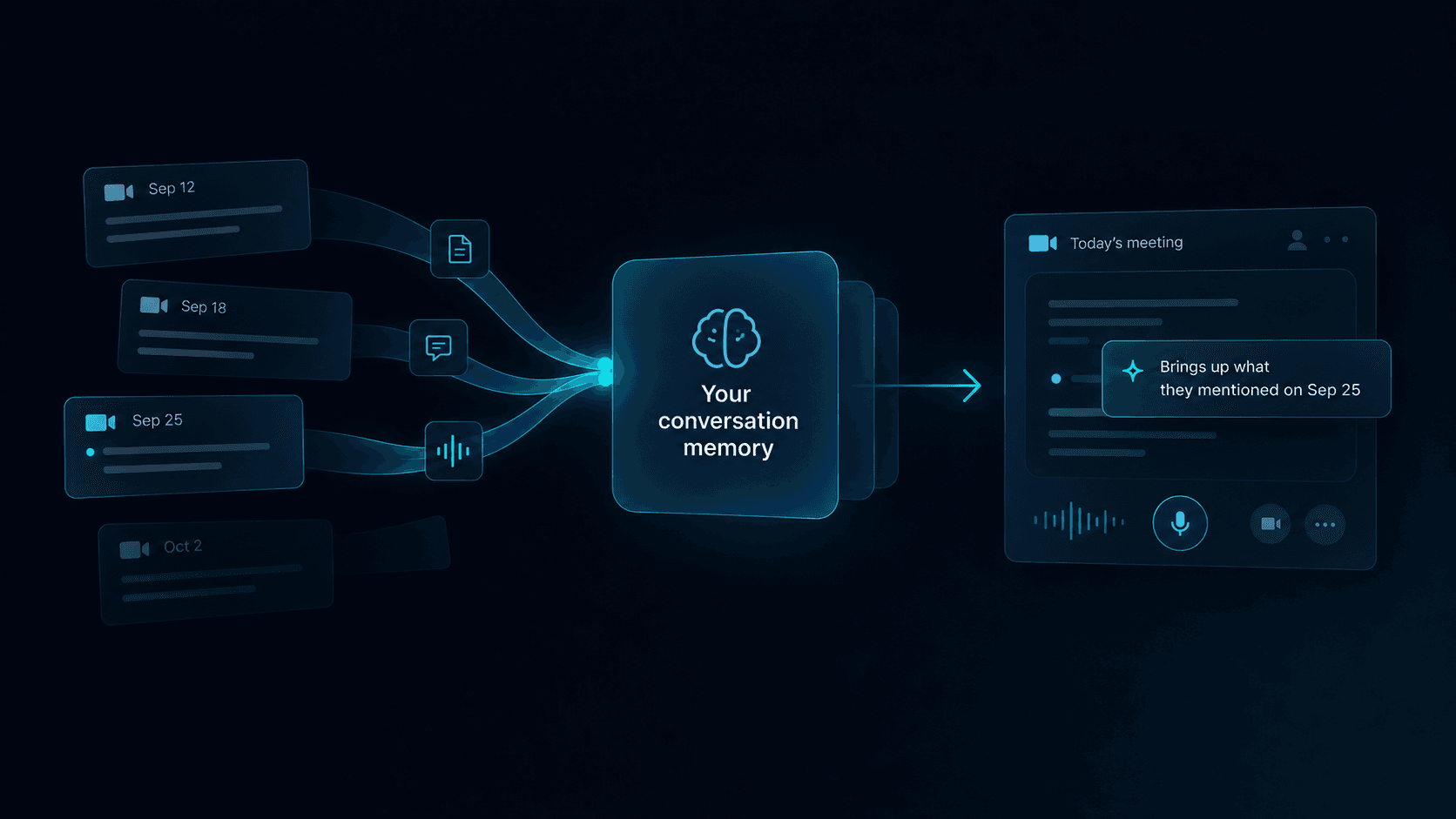
The relevant context may be spread across prior calls, company knowledge, customer history, decisions, and unresolved questions. In sales and customer-facing conversations, kernous helps bring those pieces together around the conversation that is happening now, so the person on the call can stay present instead of searching for what they already know.
Before a call, that means understanding what matters about the account without reconstructing the full history manually.
During the conversation, it means making relevant context available when the topic shifts, so the person on the call can stay present and use their own judgment.
Afterward, the new decisions, concerns, and commitments become part of what the next conversation with that customer can carry forward.
The result is a continuous understanding that develops alongside the relationship.
When the next call begins, the customer doesn't have to repeat themselves, and the person on the call can spend less time recovering the past and more time moving the relationship forward.
See how kernous brings relevant customer context into view during a live conversation: try the demo.
FAQ
What is conversation continuity in sales?
Conversation continuity is the preservation of relevant customer context across separate sales conversations. It allows the next call to begin with an understanding of what has already happened with that customer, what matters now, and what remains unresolved, without asking the customer to repeat themselves.
Why is customer context lost between calls?
Context is often distributed across call transcripts, CRM notes, emails, chat messages, and individual memory. Summaries may also preserve the topic without capturing why it mattered, while rep handoffs and changes over time make older information harder to interpret.
How do you maintain context across customer conversations?
Capture decisions, concerns, commitments, open questions, ownership, and changes after each call. Connect those details to their original sources and surface the relevant parts before or during the next conversation with that customer.
What customer information should carry into the next call?
The next call should inherit the customer's current objective, important prior decisions, unresolved questions, constraints, commitments, owners, relationship context, and any material changes since the last conversation.
How is conversation continuity different from call notes?
Call notes describe what happened in one conversation. Conversation continuity connects that record to earlier calls, later updates, related account knowledge, and the current state of the customer relationship.
Can AI help preserve customer context between conversations?
AI can summarize calls, extract decisions and commitments, connect related conversations, and retrieve relevant customer information. People should still be able to inspect the source, understand uncertainty, and control who can access sensitive account context.