A conversation ends, and the follow-up is excellent.
The transcript is accurate. The summary captures the main points. The action items are clear. The system even identifies the moment when the customer raised a concern.
But during the conversation itself, no one had the context needed to respond.
The customer asked about an earlier commitment. The answer existed in another call note and an internal thread, but the person in the conversation could not retrieve it without stopping to search.
Post-call analysis can explain what happened.
Live conversation support is meant to help while the outcome is still being shaped.
The difference is not simply a faster version of the same tool. It is a different job.
What is post-call analysis?
Post-call analysis processes a conversation after it has ended.
Depending on the tool, it may produce:
- a transcript
- a summary
- action items
- sentiment or topic analysis
- coaching feedback
- performance scores
- CRM updates
- searchable meeting history
These outputs are useful because they reduce manual documentation and make completed conversations easier to review.
They can help a manager understand what happened, help a team prepare for the next interaction, and help an organization identify patterns across many conversations.
Post-call analysis is retrospective.
Its main question is:
What happened, and what should we learn or do next?
What is live conversation support?
Live conversation support helps a person use relevant context while the conversation is still happening.
It may surface a compact cue when the topic changes, when an earlier commitment becomes relevant, or when the current question depends on knowledge outside the immediate exchange.
Its purpose is not to analyze the conversation afterward.
Its purpose is to reduce the gap between the moment someone needs context and the moment they can use it.
Its main question is:
What matters now, before this moment passes?
That context might include:
- a relevant decision from an earlier conversation
- an unresolved question
- approved product or policy information
- previous troubleshooting history
- an assumption behind a metric
- a concise reminder of what was promised
- a source that can be checked without leaving the conversation
The person still decides what to say and what to do next.
The clearest difference is timing
Consider a customer asking:
“Your team said this would be resolved before renewal. Is that still the plan?”
A post-call system can later identify that the customer raised a renewal risk. It can add the issue to a summary, assign a follow-up, and flag the moment for review.
Those actions may be useful.
But they do not help the person answer the question while the customer is waiting.
Live conversation support addresses the earlier moment.
Instead of waiting until the call ends, it may surface a short cue showing that the commitment was previously discussed, that the issue remains unresolved, or that a specific internal source contains the latest status.
The information does not need to make the decision.
It needs to restore enough context for the person to respond accurately.
A before, during, and after example
Imagine a customer-success conversation about an upcoming renewal.
Before the conversation
The account manager reviews:
- the renewal date
- recent usage
- open support issues
- previous commitments
- the likely agenda
Preparation helps, but it cannot predict exactly which issue the customer will bring up.
During the conversation
The customer asks about a limitation that another team discussed three months earlier.
Without live support, the account manager may need to search notes, open multiple tools, or promise to follow up later.
With live support, a concise cue might remind them that the limitation was previously discussed and point them toward the relevant supporting context.
The person can acknowledge the history, avoid making an unsupported promise, and decide whether the issue needs escalation.
After the conversation
A post-call system can summarize the renewed concern, capture the agreed next step, and preserve the unresolved issue for the next interaction.
All three stages matter.
The mistake is assuming that strong post-call analysis can replace support during the conversation—or that live support makes post-call documentation unnecessary.
Post-call analysis and live support solve different failure modes
Post-call analysis is strongest when the problem is:
- incomplete documentation
- inconsistent follow-up
- limited visibility for managers
- difficulty reviewing many conversations
- missing action items
- weak organizational learning
Live conversation support is strongest when the problem is:
- context exists but cannot be found quickly
- the topic changes unexpectedly
- the current question depends on previous history
- searching would disrupt the interaction
- the person risks making an inaccurate statement
- the moment will pass before a follow-up can help
One system looks backward to make the completed conversation more useful.
The other supports judgment while the conversation is still open.
Why post-call insights often arrive too late
A post-call summary may correctly say:
“The customer expressed concern about a previous commitment.”
That is useful for the record.
But during the call, the real need was more specific:
- What was actually promised?
- Who made the commitment?
- Is it still open?
- What information can be stated confidently?
- What should not be promised yet?
The difference is between identifying a topic and restoring usable context.
Post-call analysis can be accurate without changing the moment that mattered.
This is why the right answer can still arrive too late.
Why live support should not become constant prompting
The solution is not to place more information on the screen throughout the conversation.
Live support creates its own risk: interruption.
A cue may be relevant but still unhelpful if it is too long, appears too often, or demands attention at the wrong time.
Useful live support should be:
Selective
Not every detected topic deserves a prompt.
The information should appear only when it can materially improve the next response, question, or decision.
Brief
The first layer should be readable at a glance.
A live conversation is not the right moment for a full report.
Traceable
The person should be able to understand where the context came from.
Optional
The cue should support attention rather than compete for it.
The person should remain in control of whether to use, dismiss, or explore the information.
Judgment-preserving
The system should not turn a complex conversation into a rigid sequence of suggested responses.
The value comes from better context, not from replacing the person’s interpretation.
Action value versus interruption cost
A useful way to evaluate live support is to compare action value with interruption cost.
Action value is the degree to which the context could improve the person’s next move.
Interruption cost is the attention required to understand and use it.
A short reminder about an unresolved commitment may have high action value and low interruption cost.
A long account history may also be relevant, but its interruption cost is too high to place directly in the conversation.
The goal is not to surface everything that might be related.
The goal is to surface what is useful enough to deserve attention now.
The same distinction applies beyond sales
Although many conversation tools are marketed around sales, the timing distinction appears in many kinds of live work.
Customer success
A customer refers to an earlier promise or unresolved issue.
The post-call need is to document the concern. The live need is to understand the history before responding.
Investor conversations
An investor challenges a current metric by referring to an older assumption.
The post-call need is to record the follow-up. The live need is to recover the reasoning behind the number.
Service and support
A customer reports that the same problem has happened before.
The post-call need is to update the case. The live need is to understand what has already been tried.
Internal and advisory conversations
A discussion shifts from a current decision to the rationale behind an earlier one.
The post-call need is to document the outcome. The live need is to restore the relevant decision context.
The content changes across scenarios.
The distinction does not: analysis after the conversation and support during the conversation serve different moments.
When do teams need both?
Most teams do not need to choose one or the other.
They need continuity across the full conversation lifecycle.
Before the conversation, people need relevant preparation.
During it, they need context that responds to what is actually happening.
Afterward, they need decisions, commitments, and unresolved questions to be captured and carried forward.
A strong system connects these stages instead of treating them as separate information silos.
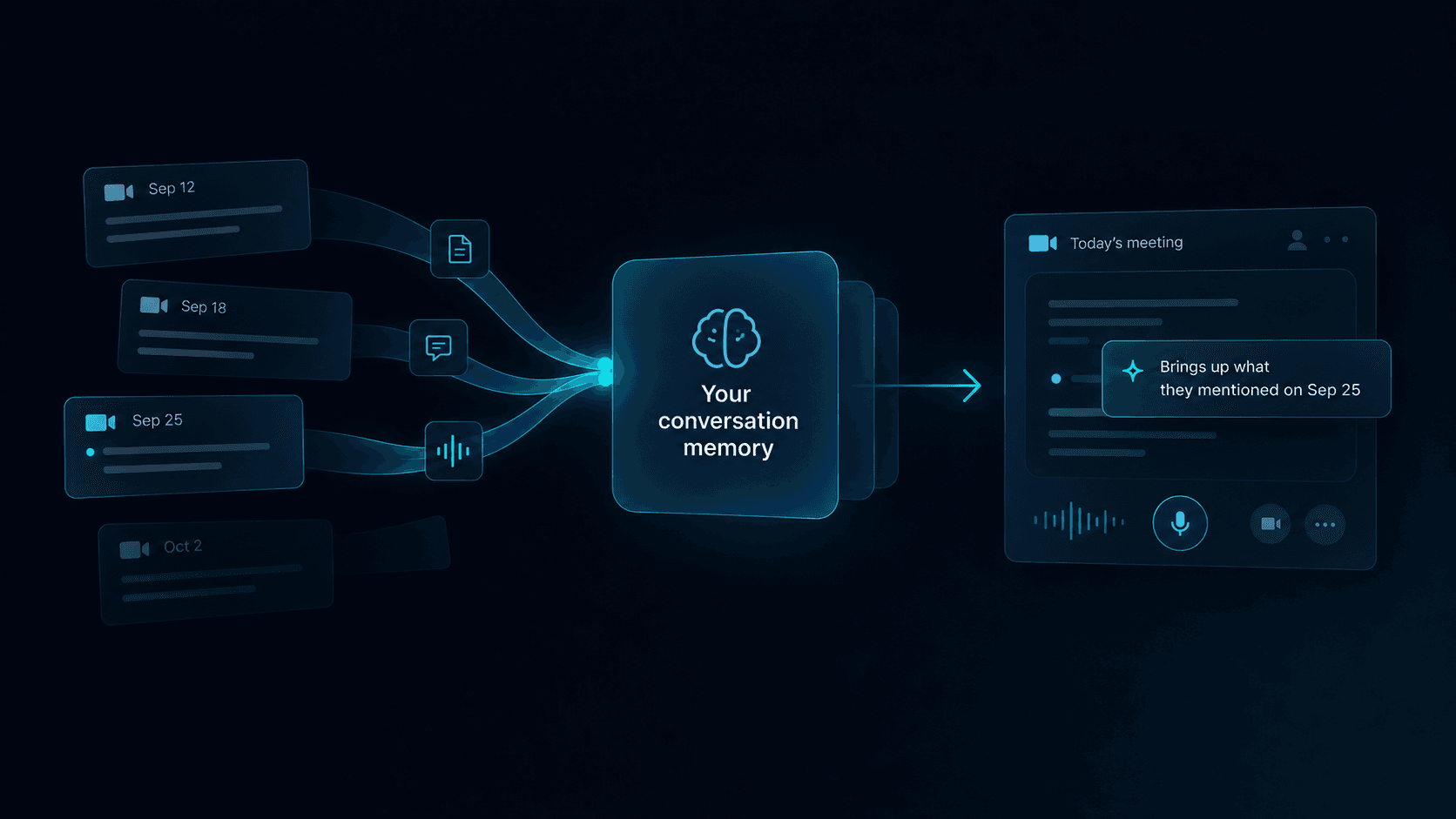
The context created after one conversation should become useful before and during the next one. That connection across meetings is what conversation continuity describes.
Where kernous fits
kernous is a second brain for live conversations. It surfaces the right context the moment the conversation shifts.
Rather than waiting until the conversation ends to explain what happened, kernous is designed to surface compact, relevant cues while the person can still use them.
When a conversation refers to an earlier commitment, unresolved issue, product detail, or previous decision, kernous can surface a compact cue with a short, relevant summary and the supporting context needed to decide what to do next.
The first layer should be short enough to understand without leaving the conversation. More detail can remain available when it is useful.
This does not replace post-call documentation or analysis.
It addresses a different gap: making organizational memory usable while the conversation is still moving.
Related reading:
- What Is a Second Brain for Live Conversations?
- Real-Time Help During Sales Calls
- Real-Time Sales Coaching: Live Guidance for Calls
- Sales Call Notes: How to Capture What Matters for the Next Conversation
- Conversation Continuity: How to Carry Context From One Business Conversation to the Next
How to evaluate the two categories
When comparing tools, ask which stage of the conversation they are designed to improve.
For post-call analysis:
- Does it produce an accurate transcript or summary?
- Does it capture decisions and action items?
- Does it help teams review completed conversations?
- Does it make follow-up and reporting easier?
For live conversation support:
- Does context appear quickly enough to affect the current interaction?
- Is it relevant to the exact topic being discussed?
- Is it concise and traceable?
- Can the person ignore or explore it?
- Does it reduce searching without increasing distraction?
- Does it preserve human judgment?
The right evaluation depends on the problem the team is trying to solve.
FAQ
What is the difference between live conversation support and post-call analysis?
Post-call analysis explains and organizes what happened after a conversation. Live conversation support helps a person use relevant context while the conversation is still happening.
Can post-call analysis help during a live conversation?
Usually not directly. It may improve preparation for future conversations, but it cannot change a moment that has already passed.
Does live conversation support replace meeting notes or summaries?
No. Live support and post-call documentation serve different purposes. Teams may need both.
Is live conversation support the same as real-time coaching?
Not necessarily. Real-time coaching often focuses on suggested behaviors or responses. Live conversation support can focus more broadly on retrieving relevant knowledge, history, and decision context.
Should live support show information constantly?
No. It should be selective. Context should appear only when its value is greater than the interruption it creates.
Can the same system support before, during, and after a conversation?
Yes. A connected system can use previous context for preparation, surface relevant information during the conversation, and preserve new decisions afterward.